There is something fascinating about Navratri: the festival has the same name, the same nine-night rhythm and a shared connection with Shakti, yet it can look completely different depending on where you are in India.
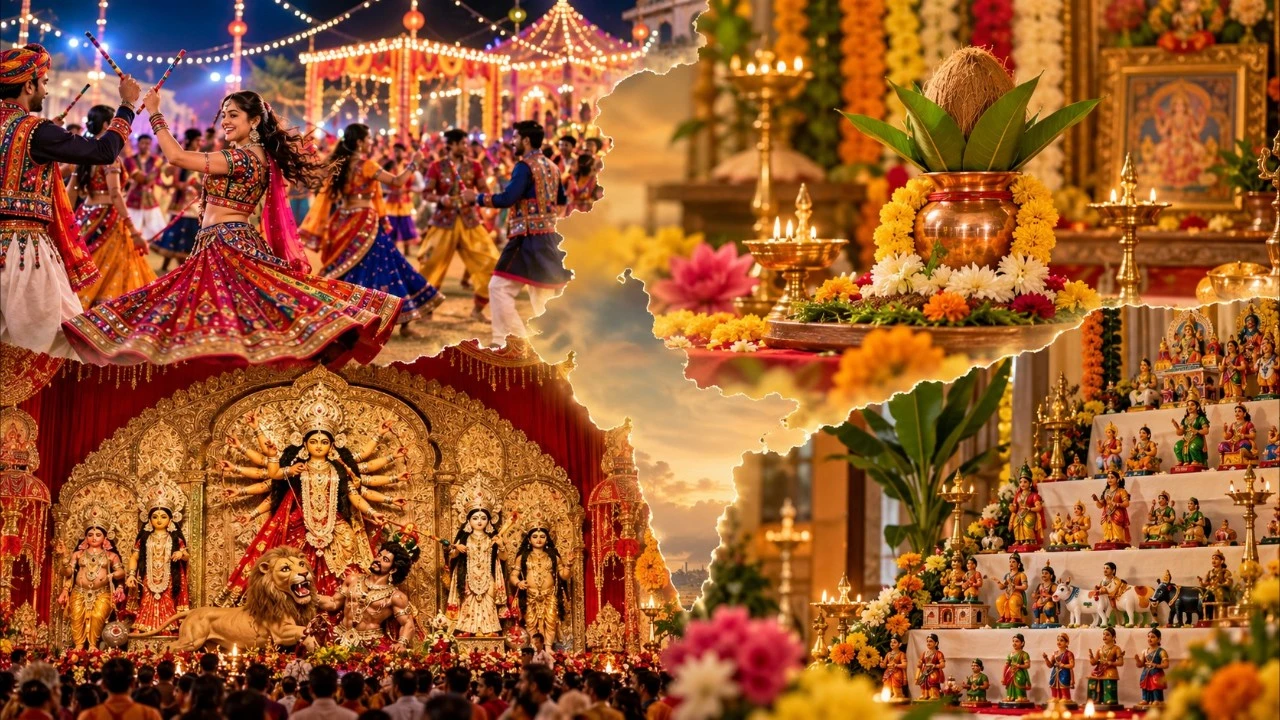
In Gujarat, the nights come alive with Garba and Dandiya. In West Bengal, the focus shifts to magnificent Durga Puja pandals and artistic idols. In Maharashtra, devotion blends with family traditions, festive colors and community celebrations. In North India, Navratri connects closely with Ramlila and the story of Lord Rama, while parts of South India celebrate with beautifully arranged Golu or Kolu displays.
The result is not one Navratri, but many versions of the same festival—each shaped by local history, customs and the people who celebrate it.
And that may be the most beautiful thing about Navratri: the tradition changes from place to place, but the spirit of devotion, togetherness and celebration remains.
When Is Navratri in 2026?
Sharad Navratri begins on Sunday, October 11, 2026, and the nine-day festival continues through Monday, October 19. Vijayadashami or Dussehra follows on October 20.
The festival begins with Ghatasthapana, also known as Kalash Sthapana, a ritual associated with invoking the presence of Goddess Durga. Maharashtra Tourism describes it as an important ritual marking the beginning of Navratri.
But once the prayers begin, the way people celebrate can vary dramatically.
One Festival, Many Traditions
Navratri is traditionally associated with the worship of Goddess Durga and her nine forms, collectively known as the Navadurga. The festival is also connected with the victory of good over evil and, in many traditions, culminates in Dussehra. Incredible India
Yet India's regional diversity gives the festival its own character in different parts of the country.
Here's a quick look:
Region | What Makes Navratri Special |
|---|---|
Gujarat | Garba, Dandiya, music and community dancing |
Maharashtra | Devi worship, Ghatasthapana, festive traditions and Dussehra |
West Bengal | Durga Puja, elaborate pandals and artistic idols |
North India | Fasting, Ramlila and Dussehra celebrations |
South India | Golu/Kolu displays, devotional gatherings and festive visits |
Let's look at what makes each tradition unique.
Gujarat: When Navratri Becomes a Nightly Celebration
If there is one place where Navratri is almost synonymous with dance, it is Gujarat.
Across the state, communities gather for Garba, a traditional circular dance performed in honor of the divine feminine. Dandiya also forms an important part of the celebrations, with participants dressed in colorful traditional clothing and dancing to rhythmic music.
Gujarat Tourism describes the festival as a nine-night celebration centered around Shakti, with large community gatherings and Garba performances.
What makes Gujarati Navratri particularly interesting is that the celebration isn't confined to temples. Residential communities, open grounds and large public venues can all become spaces for Garba.
So while the religious meaning remains at its heart, Navratri also becomes a celebration of music, movement, clothing, friendship and community.
The flower connection
Flowers naturally become part of this festive atmosphere—whether they're used for home entrances, puja spaces, decorations or as thoughtful Navratri gifts for family and friends.
Maharashtra: Devotion Begins at Home
For many families in Maharashtra, Navratri begins with Ghatasthapana, the ceremonial establishment of the Kalash.
Maharashtra Tourism describes the ritual as an invocation of Goddess Shakti, involving elements such as soil, barley, a water-filled Kalash, coconut, sacred leaves, flowers and other puja materials. Department of Tourism Maharashtra
The nine forms of Goddess Durga are worshipped during the festival, while families and communities observe their own traditions around prayers, fasting and celebration.
Maharashtra also has a strong connection between Navratri and the broader Dussehra celebration.
On Dussehra, traditions can include Shastra Puja, worship of tools and implements, and the exchange of Apta or Shami leaves as a symbolic gesture of prosperity and goodwill.
This gives Navratri in Maharashtra a particularly interesting character: it can be deeply devotional while also remaining closely connected to family, work, community and everyday life.
West Bengal: When Navratri Becomes Durga Puja
Travel east and the atmosphere changes completely.
In West Bengal, the final days of the Navratri period are closely associated with Durga Puja, one of India's most spectacular cultural celebrations.
Kolkata's streets become filled with elaborately designed pandals, artistic Durga idols, lights, music and enormous crowds. The main celebrations peak around Shasthi, Saptami, Ashtami, Navami and Dashami.
And here, flowers aren't merely background decoration.
They become part of the visual language of the festival—appearing around idols, puja spaces, entrances and homes. Floral decoration works alongside lighting, artwork and traditional elements to create the distinctive atmosphere of Durga Puja.
That combination of devotion + art + flowers + community is one reason Kolkata's celebration feels so different from Garba nights in Gujarat.
North India: Navratri, Ramlila and the Road to Dussehra
In many parts of North India, Navratri has a strong connection with the story of Lord Rama and Ravana.
Ramlila performances retell episodes from the Ramayana during the festive period, eventually leading to Dussehra and the symbolic burning of Ravana's effigy.
The Ministry of Tourism describes North Indian Navratri as nine days of devotion that culminate in Dussehra, while Ramlila forms an important part of the regional celebration. Incredible India
This gives the festival a different emphasis.
Instead of the night being centered primarily around Garba or the artistic spectacle of Durga Puja, the narrative of good overcoming evil becomes especially prominent.
South India: The Beautiful World of Golu
In parts of South India, Navratri takes another fascinating form through Golu or Kolu displays.
Families arrange dolls and figurines on specially prepared steps or platforms, creating displays that can represent deities, people, stories and scenes from everyday life.
The Ministry of Tourism highlights Kolu displays as one of the distinctive ways Navratri is celebrated in South India.
Visiting homes during the festival can become part of the celebration itself, making Navratri a social occasion as much as a religious one.
Instead of a large public Garba ground or a massive Durga Puja pandal, the centre of the celebration may be a carefully arranged space inside someone's home.
And that tells us something important about Indian festivals:
A celebration doesn't need to be enormous to be meaningful.
Sometimes a decorated corner, a few flowers, family members and a shared prayer are enough.
Why Do the Nine Navratri Colors Change?
The colors associated with Navratri are another tradition that has become increasingly visible across India.
People often wear the designated color of the day, turning the nine-day festival into a colorful visual celebration.
For 2026, the commonly observed color sequence listed by Maharashtra Tourism is:
Day | Date | Color |
|---|---|---|
Day 1 | October 11 | Yellow |
Day 2 | October 12 | Green |
Day 3 | October 13 | Grey |
Day 4 | October 14 | Orange |
Day 5 | October 15 | White |
Day 6 | October 16 | Red |
Day 7 | October 17 | Royal Blue |
Day 8 | October 18 | Pink / Peacock Green |
Day 9 | October 19 | Purple / Violet |
Maharashtra Tourism associates each day's color with the corresponding form of the goddess and its traditional symbolism.
The colors also create a fun way for families, friends and communities to participate together.
A yellow outfit one day, green the next, followed by red or royal blue—the festival gradually becomes a visual story of its own.
The Same Festival Can Feel Completely Different
This is perhaps the most interesting thing about Navratri.
Imagine celebrating the festival in three different cities.
In Ahmedabad, you might spend the evening dancing Garba with hundreds of people.
In Kolkata, you might spend the same period walking between beautifully designed Durga Puja pandals.
In Maharashtra, your celebration might begin quietly at home with Ghatasthapana and daily prayers.
All three are Navratri.
The rituals, music, food, clothing and atmosphere may be different, but the underlying themes—devotion, Shakti, renewal and the triumph of good over evil—connect them.
Why Flowers Have a Natural Place in Navratri Celebrations
Flowers have always been closely associated with Indian worship and festive decoration. During Navratri, they can be used to decorate a home temple, entrance, puja space or festive table. Marigold garlands are especially familiar in Indian celebrations, while other flowers can be chosen according to local traditions and family preferences.
Flowers are also part of traditional Navratri rituals. Maharashtra Tourism's guidance for Ghatasthapana, for example, includes flowers and flower garlands among the materials associated with the puja.
But the flowers of Navratri can mean more than decoration. Different flowers are traditionally associated with the nine forms of Goddess Durga, giving them a deeper symbolic connection to the festival.
If you're curious about the traditional flowers associated with each day of Navratri and the symbolism behind them, explore our guide to the nine Navadurga flowers and their symbolism.
Flowers can also be a simple way to send festive wishes to someone you cannot celebrate with in person. A thoughtful bouquet can say, “I was thinking of you this Navratri,” without making the gesture feel overly formal.
For those looking for flowers for Navratri, the best choice is often one that feels appropriate to the recipient and the way their family celebrates.
What Can You Send Someone During Navratri?
Navratri gifting doesn't have to mean buying an elaborate present.
Think about what the person actually enjoys and how they celebrate the festival.
For parents and elders
A tasteful flower arrangement, devotional gift or festive hamper can be a warm way to send your wishes when you cannot visit personally.
For friends
A small floral arrangement, chocolates or a festive gift can work well—especially if your friend is celebrating Garba or attending community events.
For family members living away
A thoughtful combination of flowers, sweets, chocolates or another gift can help make the festival feel a little closer to home.
For a Navratri gathering
If you're visiting someone's home during the festival, a simple floral arrangement or suitable festive gift can be a thoughtful gesture.
The important part is not the price.
It's the thought behind the gesture.
A Better Way to Celebrate Navratri From Far Away
Modern life has changed how we celebrate festivals.
Parents may live in one city while their children work in another. Friends may move across the country. Siblings may not be able to return home every year.
But festivals still give us an opportunity to bridge that distance.
You might not be able to join the Garba night.
You might not be able to visit the Durga Puja pandal.
You might not be able to sit beside your family during the evening aarti.
But you can still send a small reminder that you're thinking about them.
That's where a thoughtfully chosen flower bouquet, festive gift or gift combination can become more meaningful than simply being another delivery.
BetterGiftFlowers™ offers flowers, cakes, chocolates, personalized gifts and combinations that can be chosen according to the person and occasion.
Navratri Is More Than Nine Days
It is easy to think of Navratri as nine colors, nine nights, Garba songs, fasting and festive clothing.
But look closer and you'll find something deeper.
It is a festival that changes its language depending on where you live.
Dance in Gujarat.
Devotion at home in Maharashtra.
Art and pandals in Bengal.
Ramlila in North India.
Golu displays in the South.
Different traditions, different expressions—but a shared celebration of faith, community and the enduring idea that good can overcome evil.
And perhaps that's why Navratri continues to feel relevant generation after generation.
The way we celebrate may change.
The reason we come together does not.